



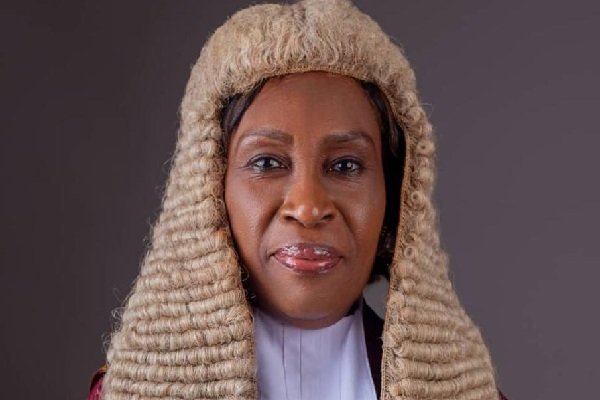
A retired Justice of the Court of Appeal, Hon. Justice Oludotun Adefope-Okojie, has asked Nigerian courts to adopt a more proactive approach in checking violations of political party constitutions and electoral laws ahead of the 2027 general elections, warning that judicial reluctance to intervene has encouraged manipulation of primaries and imposition of unpopular candidates.
She also called on election petition tribunals to order fresh elections where electoral irregularities are established but the actual winner cannot be reliably determined, rather than declaring candidates who may not have secured the people’s mandate.
Adefope-Okojie made the recommendations while delivering the 2026 Gavel International Annual Lecture in Lagos on Tuesday. The lecture, held at the Lagos Chamber of Commerce and Industry, Alausa, Ikeja, had as its theme, “Electoral Process in Nigeria: Managing the Boundaries of Judicial Intervention.”
She argued that although political parties enjoy autonomy in managing their internal affairs, such protection should not extend to unlawful practices that undermine internal democracy and violate the rights of party members.
According to her, the increasing number of election petitions in Nigeria was partly attributable to flawed party congresses, irregular primaries, wrongful substitution of candidates and other violations of electoral laws.
She said these practices had weakened political parties and encouraged aggrieved aspirants to work against their parties during general elections.
Citing statistics from the 2023 general elections, the retired justice disclosed that 1,209 election petitions were filed in respect of 1,280 contested elective positions, representing approximately 94.5 petitions for every 100 seats.
She contrasted Nigeria’s experience with Kenya, which recorded about 6.5 petitions per 100 elective seats following its 2022 elections, and Ghana, which recorded approximately 5.8 after its 2020 parliamentary elections.
She noted that only 103 of the 1,209 petitions filed after the 2023 elections succeeded, describing the volume of litigation as evidence of weaknesses in electoral administration and public confidence in the democratic process.
“The duty of the courts is to ensure that justice is done and not to shut their eyes against its bastardisation by political parties,” she said.
Citing the Supreme Court’s decision in PDP v. Alhaji Sule Lamido, Appeal No. SC/CV/164/2026, delivered on April 30, 2026, she said the judgment reinforced the principle that courts could intervene where political parties violated their constitutions and electoral laws.
She urged judges to apply the principle to prevent the imposition of candidates who did not emerge through lawful and credible processes.
Adefope-Okojie also criticised what she described as increasingly onerous evidential requirements imposed on election petitioners, particularly the demand for witnesses from individual polling units to establish electoral malpractice.
She argued that properly certified electoral documents should not be rejected merely because the officials who prepared or certified them were not called to testify.
She called for amendments to provisions requiring witnesses’ statements on oath to accompany election petitions, particularly to accommodate witnesses summoned from the Independent National Electoral Commission (INEC).
While expressing optimism that the recognition of BVAS and the INEC Result Viewing Portal (IReV) under the Electoral Act 2026 would improve evidence in election disputes, she warned that provisions relating to communication failures must not shield electoral irregularities from judicial scrutiny.
On electoral remedies, she maintained that courts should declare a candidate winner only where lawful votes clearly establish that person’s victory. Where the actual winner cannot be determined, she advocated fresh elections rather than judicially imposing a candidate.
“The Constitution places sovereignty in the people and makes the courts the guardians of that sovereignty, not its holders,” she said.
She further urged the judiciary to appoint only judges of proven integrity, competence and political neutrality to election petition tribunals ahead of the 2027 elections.
She stressed that credible elections were a collective responsibility, urging political parties to conduct transparent primaries, INEC to act impartially and the National Assembly to strengthen the framework for resolving electoral disputes.
Earlier, the Publisher of Gavel International, Mustapha Ogunsakin, described the lecture’s theme as timely, given Nigeria’s preparations for the 2027 general elections.
He recalled serving with Adefope-Okojie in 2005 on a seven-member Tribunal of Enquiry established by the Lagos State Government to investigate a bomb scare and other security incidents at the Lagos High Court premises, Ikeja. Adefope-Okojie chaired the tribunal.
Ogunsakin praised her leadership, courage and intellectual depth, recalling that the tribunal completed its assignment within the stipulated period and made recommendations to strengthen security at court premises.
The event was chaired by Chief Anthony George-Ikoli, SAN, while human rights lawyer, Mr Femi Falana, SAN, moderated the discussion. Other discussants were Dr Maureen Chigbo, Mr Ayo Olanrewaju and Mr Semiu Okanlawon.
Adefope-Okojie concluded that the ultimate objective of electoral adjudication should be to ensure that elections are won and lost at the ballot box rather than in courtrooms.