
In less than 24 hours, Ghanaians will go to the polls to elect a president and 276 parliamentarians. This election will not just be a contest to elect political leaders; it will also be a great opportunity to consolidate democratic values in a West African region recently marred by military takeovers and insurgents.
Ghanaians are no strangers to such high-stakes elections, having gone through eight previous elections in the fourth Republican constitution. But the ninth is remarkably different in many significant respects.
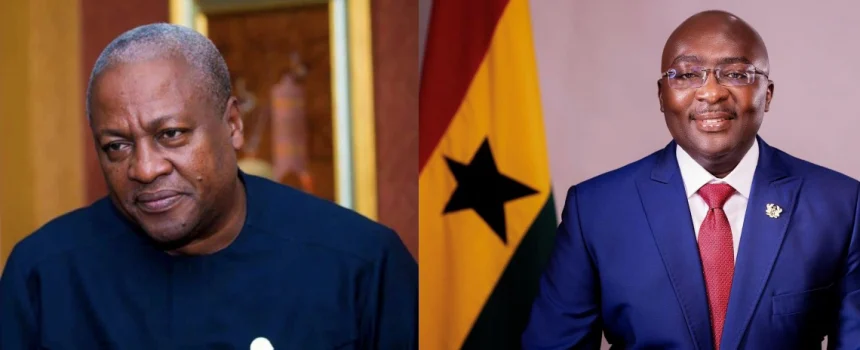
The faces of 13 presidential candidates are on the ballot papers for tomorrow, one of them deceased, but when a large chunk of the total number of registered voters, 18,774,159, turn up tomorrow at the over 40,000 polling stations, their eyeballs will be fixed on two candidates on either number one or eight on the ballot papers. The current vice president, Mahamudu Bawumia, representing the incumbent New Patriotic Party (NPP), sits at number one of the ballot paper, with his closest contender, John Mahama, the flagbearer of the National Democratic Congress (NDC), occupying the eighth.
Mr Bawumia is seeking a historic third consecutive term for the ruling party, whilst John Mahama, a former president, is seeking a return to complete his second term, which proved illusive in 2016 after he was defeated by the current president Nana Akufo-Addo.
Since 1992, none of the two leading political parties has been able to secure a third consecutive term, a feat Mr Bawumia is anxious to break but faces an uphill task.
According to a report by the National Commission on Civic Education, unemployment, health, and education remain the three key issues that will inform the election’s outcome.
While the incumbent party is trumpeting its achievements in education, digitalisation and infrastructure development, the high cost of living – partly caused by Covid-19 and Russia-Ukraine-induced global recession – mounting allegations of corruption and abuse of office, as well as unfulfilled promises are some of the immediate challenges that stand in the way of Mr Bawumia and a third consecutive term in office for his party.
On Thursday, the last day of the campaign, thousands of supporters of both parties were at rallies, a few meters apart, in Accra in a last-gasp attempt to whip up enthusiasm among their base and to get their supporters to go to the polls on Saturday.
Opinion polls have projected victory for either the NPP or the NDC. Global InfoAnalytics projects a 51 per cent victory for the opposition NDC, whilst Outcome International projects a slim victory for the NPP.
CJID, Voter Perception Survey
As part of the Ghana election, the Centre for Journalism Innovation and Development (CJID) conducted two comprehensive surveys with some exciting findings. The first, titled the “Citizen’s Perception of the 2024 Ghana General Elections”, assesses public perceptions of Ghana’s democracy, with a focus on citizens’ participation, assessment of political parties, candidates and manifesto, the electoral commission, election security, the judiciary, and media influence.
The second survey research is titled: “Information Ecosystems ahead of Ghana’s 2024 Elections: Assessing Misinformation/Disinformation Threats and Patterns, Voter Competence and Media Readiness.” The report, among other things, sought to understand Ghana’s information ecosystem ahead of the 2024 elections and media and voter readiness. It also captured the citizens’ readiness, especially first-time voters, on how to combat disinformation.
CJID, DUBAWA and election disinformation
With disinformation considered the most veritable global risk at least for the next two years, Ghana has its fair share of mis-disinformation in the heat of the campaign. The trends observed so far by DUBAWA, the fact-checking arm of CJID, have been dire, and the use of disinformation will be even higher and more sophisticated in tomorrow’s election. As part of efforts in combating disinformation and mitigating the impact of election disinformation, DUBAWA is extending its collaboration with the West Africa Network for Peacebuilding (WANEP) to monitor activities of bad actors in this election who are bent on polluting the information environment and compromising the election process.
A team of fact-checkers from DUBAWA is at the WANEP situation room for three days, Friday-Sunday, to monitor and debunk viral false and misleading claims the bad actors will be disseminating across both social and legacy media.
The WANEP observers dotted across the country will become the eyes, ears and legs for the DUBAWA fact checkers to provide independent authentication for some of the claims that will be made especially on election day.
Already, the DUBAWA team is part of the Ghana Fact-checking Coalition, made up of Ghana Fact, Fact-check Ghana, media and civil society organisations to help sanitise the election process of mis and disinformation.
Social media has been a major spreader of disinformation across the globe. As part of efforts to mitigate the spread of disinformation in the Ghana election, DUBAWA entered into a partnership arrangement with Facebook, WhatsApp and Tiktok, the most dominant apps in Ghana, to combat disinformation. DUBAWA will continue its third-party fact-checking arrangement with META aimed at flagging all false and misleading content on the platforms – Facebook, Whatsapp, Instagram, and Thread.
On Tiktok, DUBAWA will increase its Media and Information Literacy project with the help of influencers in order to build the resilience of the citizens in the fight against election disinformation.
These interventions may not be exhaustive, but they will provide a layer of protection against election disinformation as the country hopes for a peaceful election process.
Premium Times