

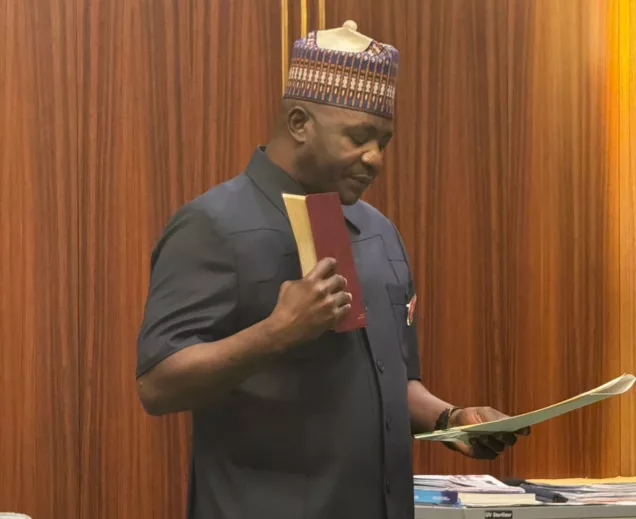
President Bola Tinubu on Thursday swore in General Christopher Musa (retd), the immediate past Chief of Defence Staff, as Nigeria’s new Minister of Defence.
This marks only the second time in the country’s history that a recently retired four-star general has been appointed to head the ministry he once served as the highest-ranking uniformed officer.
The appointment comes at a particularly turbulent moment for Nigeria’s security architecture. In the past year alone, terrorist groups and criminal gangs have intensified attacks across the North-West and North-East, while separatist agitation and oil-related militancy continue to simmer in the South-East and South-South.
The November 17 abduction of over 50 schoolgirls from Government Comprehensive Girls Secondary School in Maga, Kebbi State – just 48 hours after troops were controversially withdrawn from the facility, reignited national outrage over persistent failures to protect vulnerable citizens despite billions of naira allocated annually to defence and security.
General Musa’s Senate screening on Wednesday lasted more than five hours, one of the longest in recent memory. Senators from affected states grilled him on a litany of incidents: the killing of Brigadier-General Musa Uba, commander of 28 Task Force Brigade, in a Boko Haram ambush in Borno; repeated attacks on senior officers; the collapse of local government control in parts of Zamfara, Katsina and Sokoto; and allegations of poor coordination between the military and other security agencies.
In response, the nominee struck a conciliatory yet firm tone. “What happened in Maga is unacceptable and will not happen again under my watch,” he told the Senate.
He promised an immediate, independent investigation into the troop withdrawal order and pledged to personally review intelligence-sharing protocols.
RELATED POST: Tinubu nominates ex-CDS Christopher Musa as Defence Minister
He also committed to probing the circumstances surrounding General Uba’s death and broader patterns of targeted assassinations of military commanders.
A seasoned infantry officer with extensive counter-insurgency experience, General Musa served as Chief of Defence Staff from June 2023 until his retirement in October 2025.
Before that, he commanded Theatre Command North-East (Operation Hadin Kai) during a period widely regarded as one of the most effective phases against Boko Haram and ISWAP
His operational successes earned him both domestic praise and international recognition, though critics have occasionally accused him of being overly cautious in joint civil-military relations.
The vacancy he now fills was created by the abrupt resignation last month of Mohammed Badaru Abubakar, a close ally of President Tinubu and former governor of Jigawa State, who stepped down citing chronic health challenges.
Badaru’s 30-month tenure had been marred by escalating violence and public frustration over the military’s inability to translate huge budgetary allocations into tangible security gains.
With General Musa’s return to the defence ecosystem, this time in civilian capacity, analysts believe President Tinubu is signalling a preference for direct, hands-on military expertise at the political helm of the ministry.