
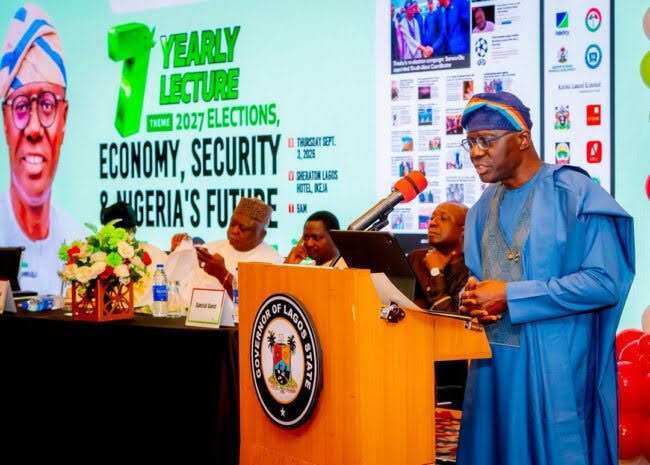

Lagos State governor, Babajide Sanwo-Olu, has knocked politicians campaigning for the return of oil subsidy, saying they are only resorting to populist politics that will eventually fail.
Former Vice President and candidate of the ADC, Atiku Abubakar had proposed to bring back the fuel subsidy regime if elected as President in 2027.
Sanwo Olu said any candidate assuring Nigerians of oil subsidy’s return was simply building their campaign on empty promises that would end up deceiving voters.
The governor stated these while delivering the 7th Freedom Online Newspaper Lecture with the theme: “2027 Elections, Economy, Security and Nigeria’s Future”, held at the Sheraton Hotel, Ikeja.
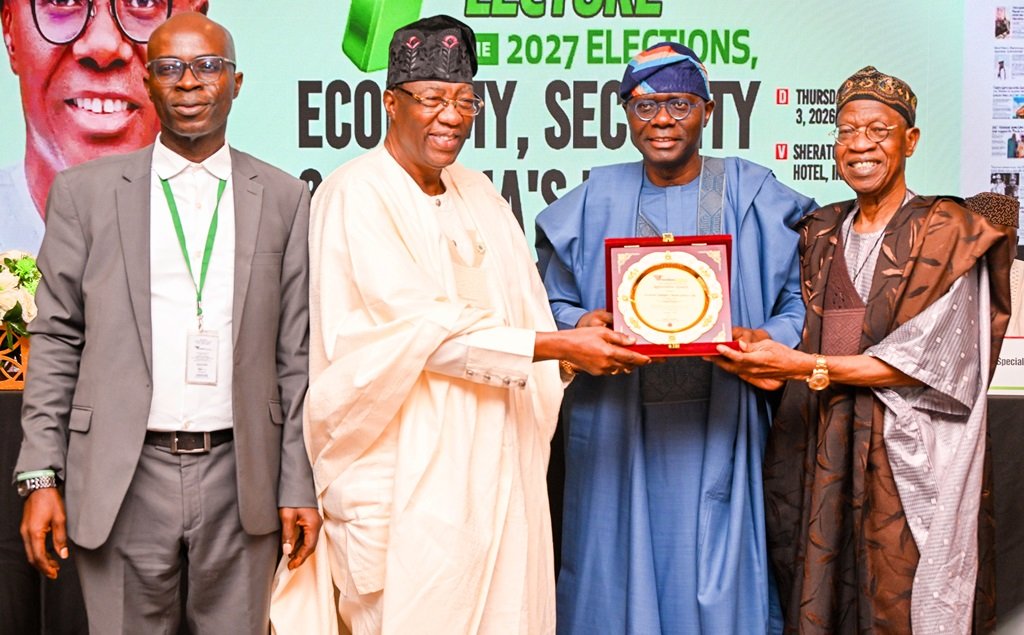
While speaking on the ongoing economic reform of the Federal Government, security matters and electoral reconfiguration, the governor highlighted the gains and the prospects for future growth.
The Lagos helmsman observed that the oil subsidy policy, which was introduced to tackle the shortcomings of local oil supplies stemming from inefficiencies at state-owned refineries, was not intended as a permanent intervention.
Sanwo-Olu said that the subsidy policy had become a burden on the nation’s finances, draining the nation’s treasury and squandering funds that could have been invested in building roads, schools, hospitals and other infrastructure relevant for the wellbeing of the nation.
By taking the courage to end the corruption-ridden subsidy programme, the Governor said President Bola Tinubu made the sacrifice that previous leaders had avoided, damning the impact the action could have on his electoral fortunes.
Sanwo-Olu said: “The oil subsidy was not removed because anybody enjoyed removing it. It was removed because it had become a hole in the national purse through which the money for roads, schools and hospitals was draining away. The intervention was never reaching the ordinary motorist it was supposed to help. In the build-up to the 2023 elections, every major candidate promised to remove it. Only one of them was in a position to do it, and he did it on his first day in office.
“I will not stand here and tell you that oil subsidy removal has been painless. It has not. Lagosians particularly have felt it at the pump, at the market, and in the price of a bag of rice. Any governor who tells you otherwise has not been listening to his own people. But the measure of a reform is not whether it hurts. It is whether it heals. And the evidence that this one is healing is now arriving, quarter by quarter.
“Under President Tinubu, the states have had it very good. Since the subsidy was removed, the monthly allocations to states and local governments have more than doubled in Naira terms. The president has done his part; the money is arriving. Barely two weeks into the season of presidential election campaign, opposition politicians have reached for the fuel subsidy as their instrument of choice. We will see more of this. We will see promises that no treasury on earth could honour.”
Chairman of the occasion and former Minister of Information and Culture, Alhaji Lai Mohammed, said the 2027 election should be viewed not merely as a contest for political power but as an opportunity to consolidate nation-building efforts.
Mohammed said the country’s security and economic challenges required consistency, patience, stronger institutions and national cooperation.
He argued that security remained a precondition for economic growth, while economic inclusion was necessary for political stability.
According to him: “No business thrives in an atmosphere of uncertainty, and no foreign or local investor deploys capital where safety cannot be guaranteed. In turn, political stability depends on economic inclusion.”
The Senator representing Ogun East senatorial district, Otunba Gbenga Daniel, said Nigeria could not achieve a strong economy without security; just as lasting security could not be achieved without a strong economy.
Daniel acknowledged what he described as encouraging signs in the Nigerian economy under the administration of President Bola Tinubu, including reported growth in the second quarter of 2026.
He, however, said economic progress should be measured beyond GDP figures and should reflect improvements in the daily lives of Nigerians.
He asked whether young Nigerians could find decent employment, farmers could safely access their farms, manufacturers could produce competitively and businesses could survive the rising costs of power, transportation and finance.
According to him, insecurity should be regarded not only as a security problem but also as an economic challenge.
“When farmers are afraid to cultivate their land, food production suffers. When roads are unsafe, the cost of transporting goods rises. When businesses spend excessively on protection, their competitiveness declines. When communities live in fear, investment is discouraged,” he said.
The Peoples Democratic Party (PDP) governorship candidate in Ogun State, Hon. Ladi Adebutu, called for stronger institutions and transparent elections as prerequisites for democratic development.
Adebutu argued that institutions must be strengthened and allowed to function effectively to restore citizens’ confidence in the political system.
He expressed concern about capital flight and the polarising effect of elections, while stressing the need for political leaders and citizens to speak truth to power.
“We need to have transparent elections. Elections have further polarised us. Our institutions should be strengthened so that people will have confidence in the system,” he said.
Earlier, the organiser and publisher of Freedom Online, Gabriel Akinadewo, said Nigeria appeared to be making progress politically but questioned whether similar progress was being recorded in other sectors.
Akinadewo called for the establishment of state police, describing insecurity as a “monster” that required urgent and innovative solutions.
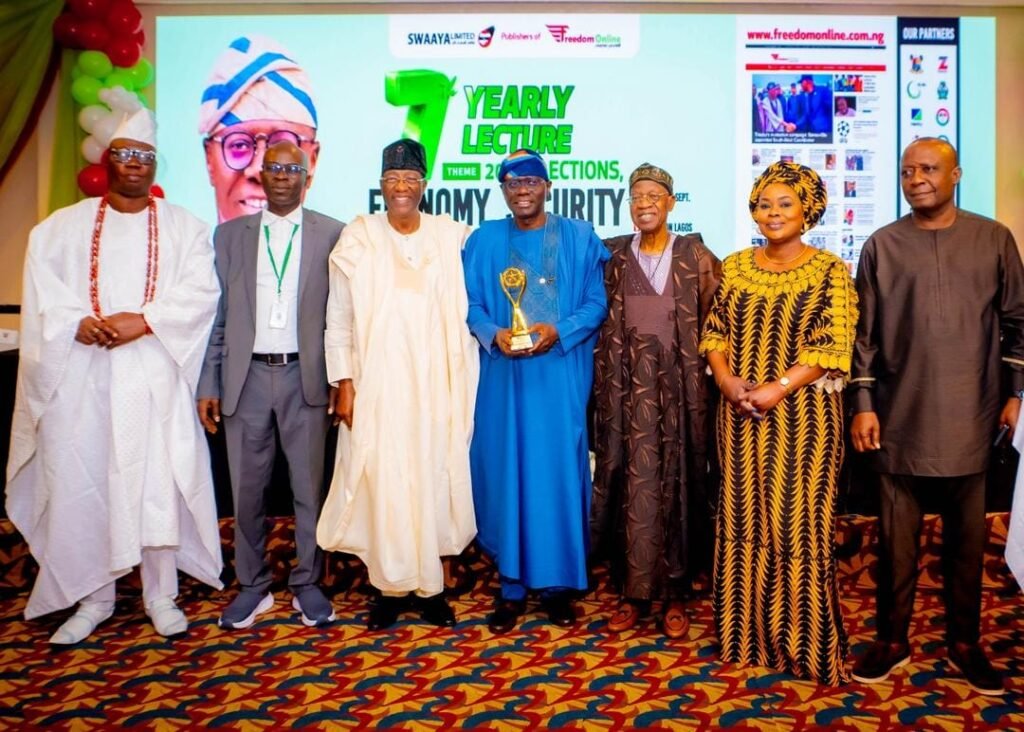
He said Nigeria had developed a four-year electoral cycle but lacked a corresponding four-year cycle of development.
“In Nigeria, every four years, we have a full cycle of election but there is no four-year cycle of development. We are here to draw a line between governance and politics. Where does politics stop? Where does development start?” he asked.
Akinadewo also called for the modernisation of Nigeria’s laws to reflect contemporary realities.
“The task before us today is very simple. We can’t continue to use the system adopted in the ’60s to govern Nigeria of 2026 and beyond. By 2027, we must modernise our laws to adapt to the challenges of the 21st century,” he said.