


By Tolulope ADEFISAYO
The political map of Osun State is changing at a speed that has left many observers gasping for air. As the state moves steadily toward the governorship election, which the Independent National Electoral Commission (INEC) has scheduled for August 15, 2026, the atmosphere is heavy with the dust of “cross-carpeting.” Everywhere you look, the famous “Umbrella” of the People’s Democratic Party (PDP) is losing its cover.
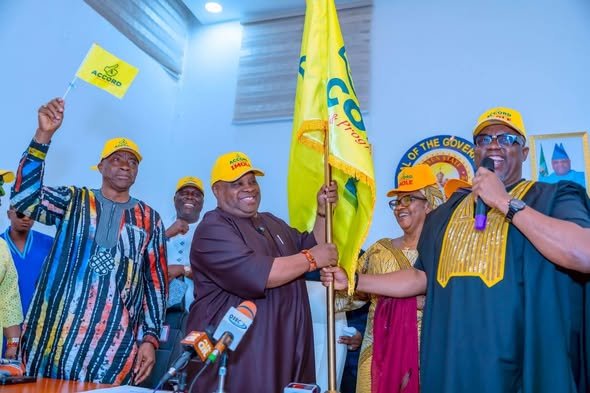
A massive wave of leaders, from the highest levels of the National Assembly to the local wards, are folding their umbrellas and picking up the “Broom” of the All Progressives Congress (APC). Even the recent attempt by some to find a “third way” through the Accord Party (A) and its “Thumbs Up” sign seems to be failing, as those limbs are also being chopped off and grafted into the growing APC fold.
To understand why this is happening, we must look at the faces behind the movement. The scale of this exodus is unprecedented in the recent history of the state. It is not just the “lower cadre” workers leaving; the very pillars that held the PDP up are walking away. Leading this monumental shift are the heavyweights of the Red Chamber: Francis Fadahunsi, representing Osun East, and Senator Olabiyi Fadeyi, representing Osun Central Senatorial District. For a ruling party to lose two sitting Senators to the opposition in one cycle is more than just a setback; it is a structural collapse. These are men with vast networks and deep pockets whose exit leaves a giant hole in the PDP’s strategy.
The bleeding continues in the House of Representatives, where three “political generals” have led their troops into the APC. Busayo Oluwole Oke, a veteran lawmaker with massive influence in Obokun/Oriade Federal Constituency, has not only defected but has been appointed the Director-General of the APC campaign. He is joined by Omirin Emmanuel Olusanya and Ajilesoro Abimbola Taofeek.
These three men represent the engine room of grassroots mobilization in their respective federal constituencies. When a Representative defects, he doesn’t go alone. He moves with his local coordinators, his ward chairmen, and the thousands of voters who look to him for direction. This is why the APC’s fortunes are looking brighter with every passing day. But it isn’t just the current officeholders who are leaving.
The party’s foundation is being dug up. We have seen the departure of elder statesmen like Shuaib Oyedokun, a founding father of the PDP whose presence gave the party institutional memory and respect. Alongside him is Dotun Babayemi, a man who fought hard for the soul of the party and commands a loyalist base that is arguably the most organized in the state. We also saw the exit of Kayode Oduoye, another major stakeholder who brought youthful energy and resources to the party. Their movement to the APC suggests that the elders have looked at the future of the PDP and decided that the house is no longer habitable.
The most recent and perhaps most stinging blow came from within the state’s own legislative house. Adesina Atanda Rabiu, the member representing Iwo State Constituency in the Osun State House of Assembly, has officially dumped the governor’s camp for the APC. Iwo is a major political hub, and having a sitting Assembly member leave the “Governor’s camp” to join the opposition sends a clear message: the fire is burning inside the house. When those who are supposed to be the Governor’s foot soldiers in the Assembly start resigning their membership, it indicates a total breakdown in trust and internal democracy.
So, why are these “calamities” happening? From a sociopolitical perspective, the answer is simple: the “social contract” within the PDP has broken. In politics, people stay together when there is a sense of inclusion, fairness, and a clear path to the future. Many of these defectors complain that the party has been hijacked by a tiny “inner circle” that ignores the contributions of those who actually won the election for them in 2022. When political actors feel that their influence is being systematically erased, they don’t sit still – they look for a platform where they are valued.
Furthermore, the “lame duck” perception is beginning to set in. Despite the bravado of party spokesmen, the daily resignations of political appointees and elected members suggest that people are “voting with their feet” ahead of the actual election. In the sociology of power, momentum is everything. When the elite start leaving in droves, it creates a psychological effect on the masses. The average voter begins to believe that the current government is a sinking ship, and the APC, led by its gubernatorial candidate Asiwaju Munirudeen Bola Oyebamiji (AMBO), is the lifejacket they need.
There is also the factor of Governor Ademola Adeleke’s “newfound love” for the Accord Party. Some naysayers are not asking the right questions about why the Governor’s allies tried to prop up the Accord Party and its “Thumbs Up” sign as a backup plan. The reality is that this move has backfired. Instead of providing a safe haven for PDP members, the Accord Party is itself being dismantled. The limbs of both the PDP and Accord are being chopped off and swept into the APC’s “Broom.” This suggests that the voters and the political class are tired of “alternative” arrangements and want to return to a more stable, structured opposition that can challenge the status quo.
How will this affect the fortunes of the APC on August 15, 2026? The impact will be positive and profound if handled with wisdom. First, the APC is gaining “intelligence.” These defectors know the PDP’s winning manual inside out. They know the funding sources, the mobilization tactics, and, most importantly, the weaknesses of the current administration. By bringing these leaders into the fold, the APC is essentially downloading the PDP’s entire database of political survival.
Secondly, the “AMBO train” is gaining geographic dominance. With the Senators from the Central and East, and Reps from various constituencies, the APC has effectively “colonized” the map of Osun. It will be very difficult for the PDP to campaign in areas where their former champions are now the ones leading the APC charge. The grassroots structures that once shouted “Imole” (Light) are now the ones holding the “Broom” and preparing to sweep the house clean.
However, as the Osun APC celebrates this harvest of new members, it must tread carefully. The party should learn from the mistakes of the PDP/Accord alliance and never travel the same tainted route. Elections are, at their core, about the people; winning their trust requires true internal democracy, not antidemocratic maneuvers or high-handedness.
The influx of new heavyweights must not lead to the displacement of the “old guard.” Those loyal members who have stood by the APC through thick and thin, labouring to keep the flag flying during the lean years, must not be abandoned or forgotten. A party that rewards new “converts” at the expense of its faithful foundation is only inviting the same internal crisis that is currently tearing the PDP apart.
In conclusion, the mass defections in Osun are not a fluke. They are the result of a governing party that failed to manage its success and an opposition that has opened its arms wide. As appointments are resigned and memberships are dumped virtually every day, the “Umbrella” is becoming a skeleton. For the APC, the task is now to manage this massive influx of leaders with justice and inclusion.
If the current trend continues, the August 15 election may not just be a contest; it may be the final confirmation of a shift that is already happening right before our eyes. The people are moving, the leaders are moving, and the wind in Osun is blowing firmly in one direction.
●Mrs. Adefisayo lives in Osogbo, Osun State.