

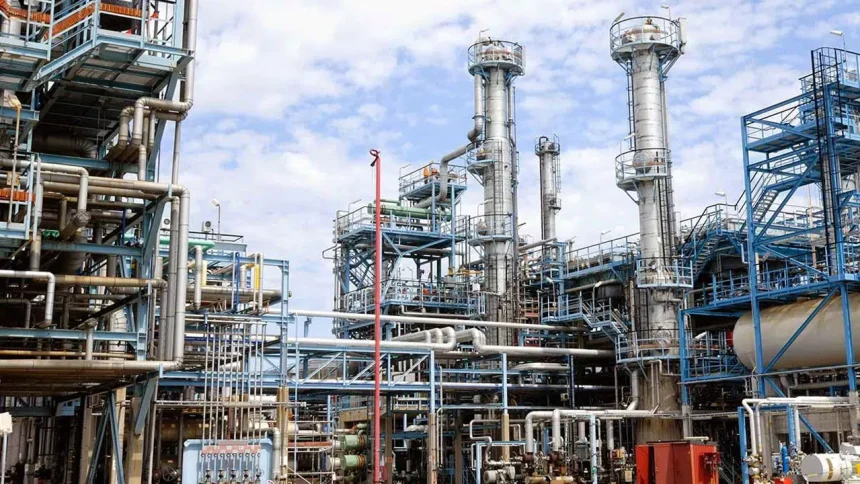
Petroleum marketers have abandoned the newly rehabilitated Port Harcourt refinery insisted that it would not buy from it if the Nigerian National Petroleum Company Limited (NNPCL) sells fuel from the plant at an expensive rate.
On Sunday, oil retailers had claimed that NNPCL was dispensing petrol from the plant at N1,030/litre. This is about N60 higher than the price of petrol produced by the Dangote Petroleum Refinery.
Although NNPCL denied the claim, it failed to state the price of petrol produced from the newly rehabilitated Port Harcourt refinery.
Speaking, the Independent Petroleum Marketers Association of Nigeria (IPMAN), said it would not buy from the Port Harcourt refinery if NNPCL sells the fuel at an expensive rate.
IPMAN said it was not expecting the Port Harcourt refinery’s petrol to be more expensive than that of the Dangote refinery or to be at par with the imported one.
The spokesperson of the association, Chinedu Ukadike, while speaking in an interview on Saturday, said fuel from the Port Harcourt refinery should be more affordable.
Ukadike was reacting to claims by the Petroleum Products Retail Outlet Owners Association of Nigeria that the NNPC would sell its PMS at N1,030 per litre.
He said the price was not acceptable to independent marketers so they would have to stay with another petrol source.
“If the Port Harcourt refinery’s PMs price is truly N1,030, it is unacceptable to us independent marketers. We will not buy from them. We will buy where it is cheap,” he said.
Ukadike, however, expressed hope that NNPC would review the price.
They promised to review the price. We will wait till then, but now we will buy from where it is cheaper,” he stated.
Recall that the NNPC has said it has not started selling PMS from the Port Harcourt refinery to outsiders, its products are exclusively for its retail stores at this stage.
NNPC spokesperson, Olufemi Soneye, said the price would be reviewed based on operational realities.
“Our pricing is reviewed and adjusted periodically as necessary to reflect operational realities,” he stated.
Also speaking, the Crude Oil Refineries Owners Association of Nigeria said the blended PMS from the refinery should be cheaper than the one produced directly.
CORAN National Publicity Secretary, Eche Idoko, said “It should be very cheap.”
Giving insights into the blending of petroleum products, Idoko explained that naphtha is a flammable liquid hydrocarbon mixture used as a feedstock for producing petrol, diesel, and other petroleum products. In contrast, Cracked C5 is used to break down heavier hydrocarbons into lighter ones.
He said the NNPC’s decision to blend naphtha with cracked C5 to produce petrol is likely aimed at increasing petrol production, improving petrol quality or reducing production costs.
“Blending naphtha with cracked C5 might be more cost-effective than using other feedstocks or production methods,” he stated.
However, he said some concerns have been raised about blending, including environmental impact due to the blending process releasing harmful emissions or pollutants.
He also added that the blended petrol might not meet international standards, potentially affecting vehicle performance, emissions, and safety.
He warned that if the naphtha as well as other feedstocks needed for the blending is imported, the exercise might not be sustainable in the long term.
“It’s essential to note that the NNPC’s decision to blend naphtha with cracked C5 is likely driven by various factors, including economic, logistical, and technical considerations,” Idoko explained.
An Energy Consultant, Henry Adigun, said the PMS from the Port Harcourt refinery should be around N860 to N870 because it was blended.
READ ALSO: Marketers threaten boycott of P’Harcourt refinery
Adigun said the Port Harcourt refinery is not a blending plant, but the facility is yet to attain the level where it would produce petrol directly without any need to blend.
According to him, straight-run gasoline has higher sulphur content and it must be blended to get the required standard.
“The straight-run gasoline only means gasoline with higher sulphur content. It is not illegal to blend. They blend everywhere in the world, just ensure everything is normal,” Adigun said.
Asked if the facility is more or less a blending plant rather than a refinery, he replied in the negative.
“It is not a blending plant. It’s a refinery. A refinery can also be a blending plant,” he said.
Speaking on why the refinery could not produce standard petrol that would not require any blending component, the expert explained, “They have not got to that point. Where they are now is not the stage where they can produce petrol directly. There are different refinery stages. That is the stage they are now.
“The blended product will be (more) cheaper. It should be between N860 and N870,“ Adigun disclosed.
BusinessInsider