

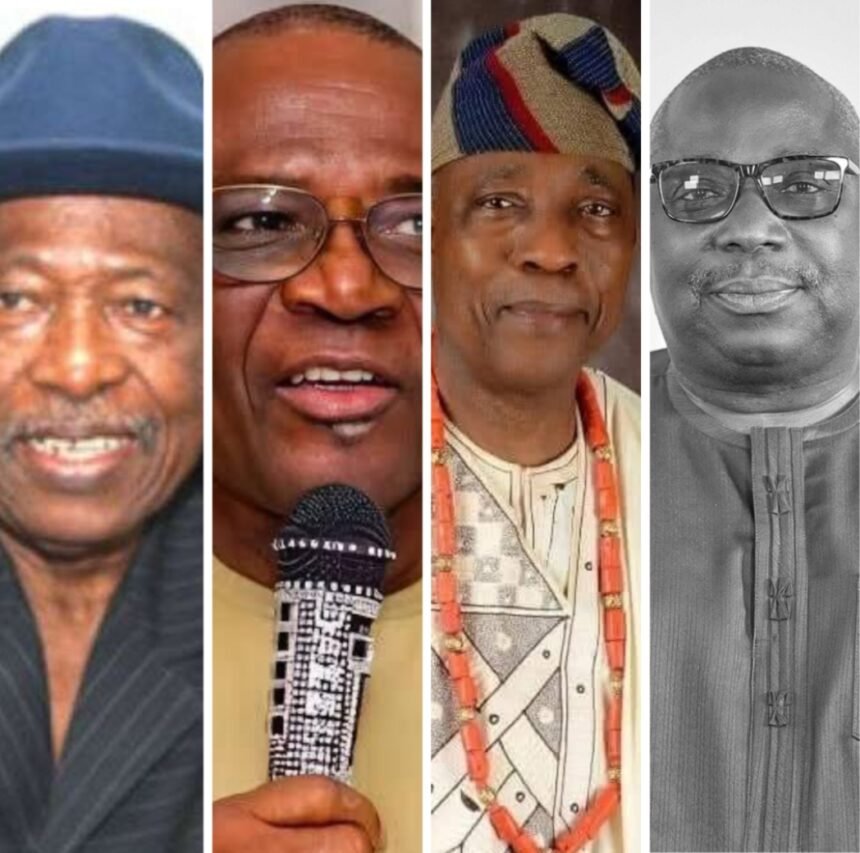

In commemoration of the 2026 Democracy Day, President Bola Tinubu, has given national awards to 51 eminent Nigerians including media icons, pro-democracy activists, and retired military officers who fought against military dictatorship during the historic June 12 struggle.
In a nationwide broadcast marking 27 years of unbroken civilian rule, the President paid glowing tributes to the late Chief M.K.O Abiola, the winner of the annulled June 12, 1993 presidential election, and other icons, stating that while Nigeria’s democracy is not perfect, it remains the ultimate vehicle for national development.
Honours list
Prominent among those listed for national awards are National Democratic Coalition, NADECO, chieftains Chief Ayo Opadokun, Chief Ralph Obioha and Dr. Arthur Nwankwo(posthumous); media veterans Lade Bonuola, Femi Kusa, Sir Ademola Osinubi, and Dele Alake; alongside activists Dr. Joe Okei-Odumakin, Richard Akinnola, and Prof. Sylvester Odion-Akhaine.
Significantly, the President recognised “soldier-democrats” who opposed military junta regimes, including Col. Sambo Dasuki, retd; Col. Lawan Gwadabe(retd), Major-General Ishola Williams, retd, and the Etsu Nupe, Brigadier Yahaya Abubakar(retd). In a major institutional honour, the President approved the renaming of the Institute of Petroleum Studies, Kaduna, as the General Shehu Musa Yar’Adua University of Geological Sciences and Engineering Technology.
Security, economic verdict
Addressing the nation’s security challenges, particularly recent student abductions in Oyo and Borno states, Tinubu declared that “democracy without security is a mirage.” He revealed that the 2026 budget commits a record N5.41 trillion to defence, alongside the recruitment of over 50,000 police officers.
“To bandits, kidnappers, and sponsors of terror: Surrender or face the full force of the Nigerian State. These windows of surrender will not remain open forever,” Tinubu warned, noting that terror-related deaths have dropped by 81% since 2015, while over 13,000 terrorists were neutralized in the past year.
On the economic front, President Tinubu defended his administration’s aggressive reforms, noting they were born out of necessity to salvage public finances. He stated that the next phase of his administration is to ensure that “democracy is felt in the pocket” of everyday citizens by tackling inflation and boosting local production.
To resolve the chronic electricity crisis, the President announced that the Presidential Power Sector Task Force has been authorized to raise a N4 trillion bond to clear legacy debts drowning the power value chain. He stated that the Electricity Act, which decentralizes power generation to states, is already yielding results.
Reaffirming his commitment to grassroots development, Tinubu emphasized his administration’s push for full financial autonomy for the 774 local government areas, attributing the rise in rural insecurity to the collapse of local governance.
Urging the political class and institutions to protect democratic guardrails ahead of the upcoming Ekiti and Osun governorship elections, Tinubu concluded: “The generation of our founding fathers secured independence—the generation of June 12 secured democracy. Our generation must secure prosperity.”