

Iran dismissed a US ceasefire proposal on Wednesday and countered with a negotiation plan of its own as intermediaries sought to keep diplomatic channels between the warring countries open.
Iranian state TV quoted an anonymous official as saying Tehran had rejected the plan it had received via Pakistan, saying it would “end the war when it decides to do so and when its own conditions are met”, and until then would continue fighting across the region.
The five-point plan Iran put forward included an end to the fighting and the assassination of its officials, guarantees that no other war is started against it, reparations for the current conflict, and Iranian control over the strait of Hormuz.
Despite the apparent Iranian rejection of the US deal, the White House press secretary, Karoline Leavitt, said discussions were continuing and were productive. She told reporters on Wednesday that “it became clear that Iran wants to talk and President Trump is willing to listen”.

Leavitt also suggested the US was sticking to its four- to six-week timeframe for ending the war, saying it had been a “resounding victory” so far. It was announced that Donald Trump’s rescheduled trip to Beijing would take place on 14 May, leading to speculation the US hoped the war would be over by then.
Intermediaries from Pakistan had delivered a 15-point ceasefire proposal to Iran earlier in the day, the Associated Press reported. It was said to include sanctions relief, the dismantling of Tehran’s nuclear programme, restrictions on its use of missiles and the reopening the strait of Hormuz, a chokepoint for about 20% of the world’s oil.
The White House said some of the reported points were in the plan, but others were not official. Some had already proved to be intractable sticking points in negotiations before the war began.
A senior Iranian official speaking to Al Jazeera described the proposal as “extremely maximalist and unreasonable”, while other officials said the country was still reviewing it, despite seeing it as too favourable to US demands.
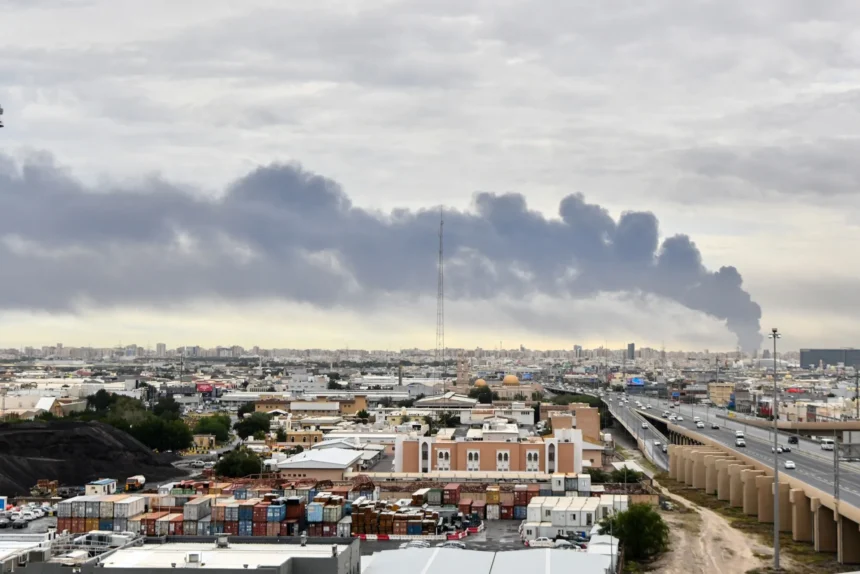
Tehran launched more drones and missiles on Israel and Gulf countries overnight and on Wednesday, including an attack that sparked a huge fire at Kuwait international airport, while Israel continued its bombardment of Iran.
Iran’s five-point plan is likely to be a non-starter for the US, particularly as it includes continued Iranian control over the strait of Hormuz, but Egyptian and Pakistani officials suggested in-person negotiations between Washington and Tehran could begin as soon as Friday, with Pakistan or Turkey as possible venues. The White House said on Wednesday that face-to-face talks were an option but cautioned reporters “not to get ahead of themselves”.
Trump said the US was in negotiations with a party in the Iranian government who was engaging with his son-in-law, Jared Kushner, the US special envoy, Steve Witkoff, the US secretary of state, Marco Rubio, and the US vice-president, JD Vance. It was unclear who exactly the US negotiating team was in contact with, as officials from Iran’s foreign ministry and military denied Trump’s statements that negotiations were taking place.
Iranian officials are sceptical about coming back to the negotiating table with the US, after the country was attacked twice before while in the middle of discussions. The US attacked Iran’s nuclear facilities during the 12-day war between Iran and Israel last summer and launched its latest conflict while progress was reportedly being made towards a comprehensive deal between the two parties.
Israel and the US have also killed much of Iran’s senior leadership, including more pragmatic figures such as the secretary of the supreme national security council, Ali Larijani, creating concerns for the safety of its Iranian interlocutors, some of whom Israel has threatened to kill.
“We have a very catastrophic experience with US diplomacy,” the Iranian foreign ministry spokesperson, Esmail Baghaei, told India Today on Tuesday.
As diplomacy sputtered forward, the US continued to amass troops in the Middle East. At least 1,000 troops from the 82nd airborne division will be sent to the region, according to the Associated Press, as well as 5,000 more marines and thousands of sailors.
The deployment of the additional troops comes as the Trump administration appears to be considering plans to invade Iran’s Kharg Island to pressure it to reopen the strait of Hormuz. The island holds 90% of Iran’s crude oil exports. The 82nd airborne division is specialised in flying into contested areas and securing them.
Iran has warned that it will carpet-bomb its own territory to attack any US troops landing there, according to diplomats from a third country who passed the threat on to Washington. Iran believes that any landing party will have limited missile defences, spelling a bloodbath for US forces.
“Iran says that they don’t care that they will have to blow up their own territory,” a diplomat involved said. “They will do it to kill American soldiers.”
The speaker of Iran’s parliament, Mohammad Bagher Ghalibaf, suggested “enemies” were planning to try to occupy Kharg Island with the help of a regional country. He said Iran would “attack vital infrastructure in that regional country in continuous and relentless attacks” if an invasion was attempted.
An unnamed Iranian military official also said Iran would target shipping in the Red Sea if the US launched a ground invasion. The move would endanger shipping in another waterway crucial for global shipping and oil transport.
“If the enemy attempts a ground operation on Iranian islands or anywhere else on our territory, or if it seeks to impose costs on Iran through naval manoeuvres in the Persian Gulf and the Sea of Oman, we will open other fronts as a surprise,” the Tasnim news agency quoted the official as saying.
Pressure has been growing domestically for Trump to find an end to the war in Iran, as Iranian attacks on Gulf energy infrastructure and the virtual blockade of the strait of Hormuz has sent prices soaring across much of the world. Oil prices fell after news of the 15-point plan broke on Wednesday, as investors hoped for an end to the biggest energy crisis in decades.
About 59% of Americans say that the US war in Iran has “gone too far”, according to a new poll. Trump’s approval rating has dropped to an all-time low of 36% owing to the increase in fuel prices and the war in Iran, according to a poll by Reuters.
Israel, by contrast, has sought to keep fighting as it tries to degrade the Iranian regime further. Israeli officials were reportedly surprised by the US ceasefire plan.
Israel continued to strike Iran on Wednesday, announcing the completion of several waves of airstrikes in Tehran, as well as the targeting of a submarine development centre in Isfahan. Iran responded in kind with ballistic missile launches targeting Israel, with missile sirens activating multiple times on Wednesday. It also targeted Arab Gulf states and Saudi Arabia said it had destroyed at least eight drones in the eastern part of the country where oil infrastructure is located.
Israel continued to pound Hezbollah targets across Lebanon, as well as engaging in ground fighting with the group south of the Litani River. The Israeli army had been slowly advancing northwards despite fierce resistance, with soldiers posting videos in the previously contested towns of Taybeh and Khiam.
The Guardian