

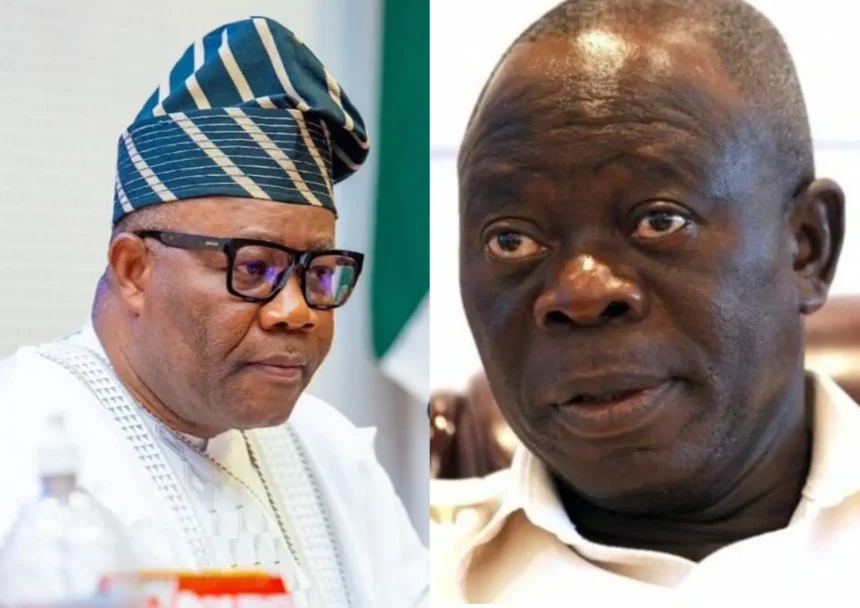

The Nigerian Senate on Wednesday descended into a tense and disorderly session that lasted over 15 minutes, following a sharp confrontation between Senate President Godswill Akpabio and Senator Adams Oshiomhole over the interpretation of the recently amended Standing Orders.
The disruption began during the routine consideration of the Votes and Proceedings of Tuesday’s plenary.
As Akpabio commenced reading, Oshiomhole (APC, Edo North) abruptly raised a point of order, drawing immediate attention from the presiding officer.
In response, Akpabio firmly reminded Oshiomhole that, in line with the Senate Standing Orders 2023 (as amended), points of order are not typically entertained during the stage of reviewing Votes and Proceedings.
Despite this clarification, Oshiomhole persisted, challenging the interpretation of the rules and insisting on being heard.
In an attempt to douse the rising tension and reinforce procedural clarity, Akpabio called on former Chief Whip, Senator Orji Uzor Kalu, to provide guidance.
Kalu supported the Senate President’s position, reiterating that the rules do not permit interruptions of that nature at the stage in question.
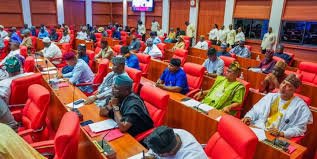
However, Oshiomhole remained defiant. The situation escalated further when Chief Whip Senator Tahir Monguno intervened, warning that he would be compelled to invoke disciplinary powers if the disruption continued.
He urged Oshiomhole to be guided and respect parliamentary decorum.
Unrelenting, Oshiomhole continued his protest, referencing Order 20(f) and arguing that all senators must be fully conversant with the rules guiding legislative proceedings. His insistence visibly frustrated the leadership of the chamber.
Clearly displeased, Akpabio issued a stern rebuke, stating, “We should not just go home, buy forms and come here without knowing the rules.”
He then delivered a direct warning to the Edo North lawmaker: “Oshiomhole, if you become unruly, we will use the rules to take you out of the Senate.”
Following the heated exchange, calm was gradually restored, allowing the Senate President to conclude the reading.
Subsequently, Senator Adamu Aliero (APC, Kebbi Central) moved for the adoption of the Votes and Proceedings, which was seconded by the Senate Minority Leader, Senator Abba Moro (PDP, Benue South).
Background to the clash
The confrontation is widely believed to be connected to the Senate’s controversial amendment of its Standing Orders on Tuesday, a move seen as having far-reaching implications ahead of the 2027 general elections.
After nearly three hours in a closed-door session, the Senate amended Orders 4 and 5 of its rules, effectively tightening eligibility criteria for presiding and principal offices in the 11th National Assembly.
Under the new provisions, only senators who have served at least two consecutive terms specifically within the 9th and 10th Assemblies will be eligible to contest for key leadership positions such as Senate President and Deputy Senate President.
The amendment significantly narrows the field, excluding many prospective entrants into the 11th Senate, including notable political figures expected to return or newly seek election.
Additionally, the revised Order 4 reinforces the long-standing parliamentary tradition of ranking, outlining a hierarchy for leadership consideration: former Senate Presidents, former Deputy Senate Presidents, former Principal Officers, and senators with prior legislative experience, down to first-time entrants only in the absence of all higher-ranking categories.
Order 5 further tightens the requirement, explicitly stating that any senator seeking a principal office must have completed two consecutive terms immediately preceding their nomination.
The immediate effect of this amendment is that only returning members of the current 10th Senate who secure re-election into the 11th Assembly will qualify to contest for top leadership positions.
Observers note that this move could reshape the power dynamics within the Senate and limit competition from incoming or returning heavyweights.
While Senate leadership maintains that the amendment is intended to preserve institutional continuity and uphold parliamentary tradition, critics argue that it may be strategically designed to consolidate power among a select group of ranking lawmakers. The clash on the Senate floor underscores the growing tension surrounding these changes and signals that debates over legislative procedures and political positioning ahead of 2027 are already intensifying within the Red Chamber.