

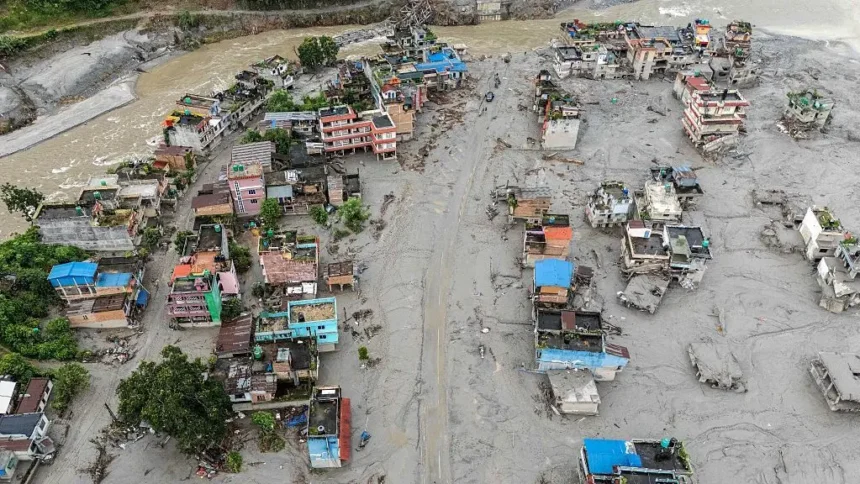

Nepal’s devastating flash floods have killed at least 669 people, while 2,362 others remain missing, as rescuers intensify efforts to locate survivors four days after a catastrophic surge swept through communities near the Nepal-China border.
The latest figures released by Nepal Police on Saturday afternoon show a significant rise in the death toll from the earlier government tally of 626. Authorities warned that the figures could continue to change as search teams reach remote and heavily damaged areas.
The disaster began on Wednesday, August 26, when a massive surge of water, ice, mud and rock raced through the Bhote Koshi and Trishuli river systems, devastating settlements in Rasuwa and downstream districts.
Authorities believe the flooding was triggered by an ice-rock avalanche and possible temporary damming of an upstream river, although investigations into the precise sequence of events are continuing.
The World Health Organization said the initial surge into the Bhote Koshi may have originated from China’s Tibet region and was possibly linked to an upstream ice avalanche.
Despite the scale of the destruction, rescue teams have continued to find survivors and evacuate people from isolated communities.
Nepal Police said 2,301 injured people have been evacuated, while thousands of others have been rescued or transported to safer locations. More than 15,000 security personnel have been mobilised for search, rescue and relief operations.
Prime Minister Balendra Shah said 4,451 survivors had been rescued in an earlier update, including 191 people pulled from a tunnel. Sixteen helicopters from the Nepal Army and private sector have been conducting shuttle flights to affected locations, with 99 flights already completed.
The government has also established mechanisms to identify and assist foreign nationals caught up in the disaster.
According to Shah, 129 foreign tourists and citizens had been rescued and identified, while the Foreign Ministry’s emergency control room was coordinating with embassies and families abroad.
The disaster has triggered an international search for hundreds of foreign nationals who were in the region for tourism, trekking and religious pilgrimages.
Nepal Police said 499 foreign nationals were still listed as missing, alongside 1,863 Nepali nationals.
The situation has generated particular concern in India, where officials said hundreds of Indian nationals remained unaccounted for. The wider disaster also affected China’s Tibet region, where Chinese authorities have reported additional deaths and hundreds missing.
The flood has caused extensive destruction across Rasuwa, Nuwakot, Dhading, Gorkha, Tanahun, Nawalparasi and Chitwan.
Homes, bridges, roads and hydropower facilities were swept away or severely damaged, while landslides have blocked access to some communities.
Rasuwa, one of the worst-hit districts, has now been reconnected to the road network, according to the prime minister. However, several remote areas remain difficult to access, forcing rescuers to rely heavily on helicopters.
The flooding has also dealt a major blow to Nepal’s hydropower sector, with several projects along the affected river corridors damaged and hundreds of workers reported missing.
Rescue efforts have been further complicated by fears of additional flooding.
An unstable lake formed by debris and ice has created concerns that another sudden release of water could send a new surge downstream.
A fresh avalanche reportedly added a large volume of ice debris to the already impounded water, while satellite observations indicated that another upstream lake was expanding without an obvious outlet.
The potential threat has forced rescuers to proceed cautiously in some areas, even as families continue searching desperately for missing relatives.
The government has begun seeking specialised international assistance, particularly for technically difficult rescue operations, identification of bodies and restoration of critical infrastructure.
India and China have already provided assistance, while other countries and international organisations have offered support. The WHO has deployed emergency medical assistance and supplies, including equipment intended to support the health needs of thousands of affected people.