
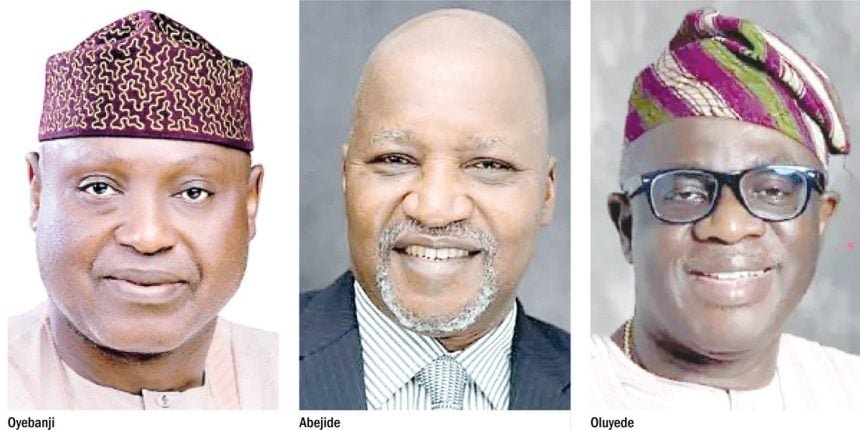

*Incumbent governor, ambassador, medical doctor in battle for Ekiti governorship
As Ekiti voters prepare to elect their next governor on Saturday, June 20, the contest appears less like a three-way race and more like a test of whether opposition parties can overcome the combined weight of incumbency, federal backing and political structure.
At the centre of the election is Biodun Oyebanji, governor of the state and candidate of the All Progressives Congress (APC), who is seeking a second term after four years in office.
His main challengers are Wole Oluyede of the Peoples Democratic Party (PDP) and Oluwadare Bejide of the African Democratic Congress (ADC).
While all three candidates have campaigned on promises of development, jobs and improved governance, the political terrain has largely favoured Oyebanji, whose re-election bid enjoys the support of the ruling party at both state and federal levels.
Oyebanji’s consensus candidacy
Oyebanji’s journey to the ballot began in October 2025 when the APC adopted him as its consensus candidate.
At the party’s primary election held at the Ekiti Parapo Pavilion in Ado-Ekiti, the state capital, 885 delegates from the state’s 177 wards affirmed his candidacy through a voice vote. The exercise, conducted under Section 84(11) of the Electoral Act, was largely uneventful and reflected the broad consensus that had already formed around the governor within the party.
The primary also demonstrated the level of elite support behind Oyebanji. Key APC figures, including Opeyemi Bamidele, senate leader, former governors, other party stakeholders, and even Ayodele Fayose, former governor of Ekiti, openly backed his re-election bid.
Since then, the governor has enjoyed the advantages that come with incumbency. His administration points to regular salary payments, ongoing infrastructure projects and a relatively stable political environment as evidence that continuity should be rewarded.
READ ALSO:
- INEC distributes election materials in Ekiti ahead of Saturday poll
- Countdown to Ekiti Poll: INEC confirms 1.06m eligible voters
More importantly, he has benefited from visible federal support. Vice-President Kashim Shettima, ministers and APC governors have repeatedly campaigned in the state, reinforcing the perception that retaining Ekiti is a strategic priority for the ruling party.
For many observers, this combination of incumbency, federal backing and party cohesion has made Oyebanji the clear favourite.
Yet critics argue that stability alone may not be enough. Rising living costs, youth unemployment and continued migration of young professionals out of the state have fuelled concerns that the administration has not delivered the transformative change many residents expected.
Oluyede and PDP’s troubled road
If Oyebanji’s path to the election has been smooth, the experience of PDP’s Oluyede has been the opposite.
Oluyede, a medical doctor, emerged as the PDP candidate in November 2025 after securing 279 votes at the party’s governorship primary, defeating his closest rival.
His campaign has centred on healthcare reform, job creation, security and a zoning argument that Ekiti south should produce the next governor.
But before Oluyede could take his message to voters, the Ikere-Ekiti-born politician had to survive a prolonged legal and political battle within his own party.
The PDP entered the election cycle deeply divided by leadership disputes and factional conflicts. The crisis spilled into the courts and eventually affected the party’s participation in the governorship race.
INEC initially omitted Oluyede’s name from both the provisional and final lists of candidates, citing unresolved court judgments relating to the party’s leadership and primary election.
The exclusion threatened to derail the PDP’s campaign entirely.
It took a federal high court judgment in Abuja, later affirmed by the court of appeal in Akure, to compel the electoral commission to recognise Oluyede as the party’s valid candidate.
Although the court victories kept the PDP in the race, party leaders privately acknowledge that the legal battles consumed valuable time and resources. While the APC focused on mobilisation and consolidation, the PDP spent months fighting for its place on the ballot.
That disadvantage continues to shape the campaign, despite energetic rallies and grassroots outreach in several parts of the state.
Bejide’s Third-Force challenge
The ADC enters the election hoping to capitalise on voter dissatisfaction with the two dominant parties.
Its candidate, Oluwadare Bejide, former ambassador to Canada, emerged from a competitive primary after defeating Kolapo Olusola-Eleka, former deputy governor, and other contenders.
Bejide brings considerable public-sector experience to the race, having served as an ambassador and as secretary to the Ekiti state government during the tenure of Segun Oni, former governor of the state.
Unlike the APC and PDP, his campaign has focused heavily on issue-based engagement, with promises centred on agriculture, infrastructure, civil service welfare and rural development.
His campaign has also relied on empowerment of the youths, direct engagement with traditional rulers, community leaders and grassroots stakeholders.
“Whatever project we are going to embark on will impact the majority of the people. The most urgent assignment for me as governor is to take our youngsters from the streets, and the only thing to do is to start by employing those who have the necessary skills,” he said.
“Apart from that, we will make agriculture more attractive to the youngsters. We will also establish skill acquisition centers as soon as possible to make their employment more competitive.”
However, the ADC faces a familiar challenge confronting third parties in Nigerian elections: limited structure.
Despite growing visibility, the party lacks the statewide network, financial resources and political machinery available to the APC. Translating goodwill into votes remains its biggest hurdle.
Federal might versus local frustration
The defining story of the election is the contest between federal influence and local economic realities.
Many residents said the Oyebanji administration has maintained relative stability and paid salaries regularly. At the same time, concerns persist over unemployment, rising prices and the limited pace of economic expansion.
Oluwamayowa Eunice, a civil servant who spoke to TheCable, summed up a sentiment expressed by several voters during the campaign.
“I don’t have anything against Oyebanji. He’s paying salary as and when it’s due. Some people still criticise him for not doing enough, but I believe he is doing his best,” she said.
Asked whether she had been aware of campaigns by other political parties, she said that although she did not attend any of their events, the opposition appeared to have mobilised effectively, both offline and especially online.
The rest of the field
Beyond the three leading contenders, 11 other candidates will appear on the ballot, although few are considered serious challengers.
Among them is Opeyemi Falegan of the Accord Party, a 41-year-old politician and community advocate from Ado-Ekiti who has campaigned as a youthful alternative to the state’s established political class.
While his message has resonated with some younger voters, limited resources and a weak party structure have constrained his reach.
Olajuyin Oyebanji, the candidate of the Labour Party (LP), is also in the race but has struggled to gain significant traction.
Also, Blessing Abegunde of the New Nigeria Peoples Party (NNPP), one of the youngest candidates at 35, has maintained a low-profile campaign and remains largely unknown across much of the state.
Other candidates from parties including the AAC, ADP, APM, APP, PRP and ZLP have participated in the campaign season but are generally not regarded as competitive enough to challenge the dominance of the APC, PDP and ADC.
In total, 14 candidates are contesting the election. Notably, all the governorship candidates are men, reflecting the continued underrepresentation of women in Ekiti’s electoral politics, with only a handful featuring as running mates.
Unlike previous governorship elections in the state, which were often characterised by intense political tension, the 2026 contest has been relatively peaceful, with campaigns largely focused on rallies, media engagement and voter outreach.
The Cable