

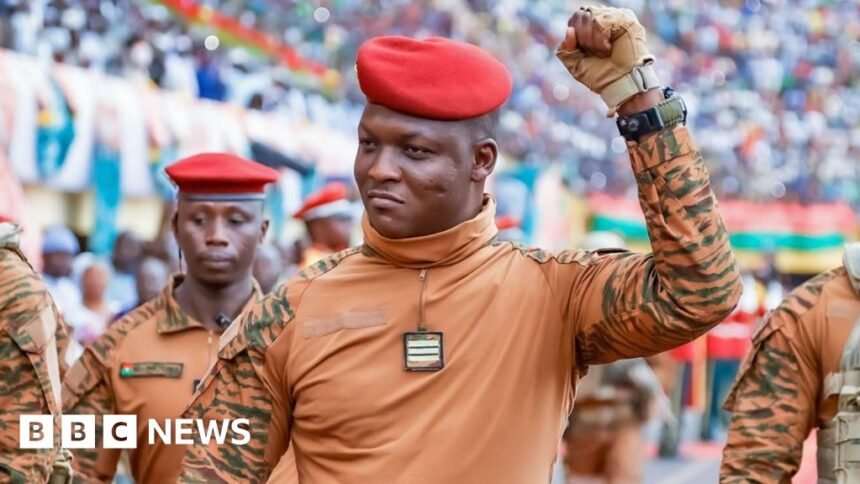

Junta leader of Burkina Faso, Ibrahim Traoré, has praised his country for its “total independence” from the Western ideals of democracy, a concept he has described as “slavery”.
Traoré spoke in an interview on Thursday night to mark the one year anniversary of the Popular Progressive Revolution (RPP), an ideological framework he launched last April to establish total national sovereignty and economic independence through anti-imperialism and by setting aside traditional democratic models in favour of revolutionary action.
“Democracy is killing. Wherever they want to install it in the world, it’s in the blood,” the junta leader said.
“Democracy is slavery. There is no democracy in this world. They impose it when they want and, to establish it, they kill.
“Imperialism is the individual who wants to dominate the other, keep him in slavery and oppress him.”
After seizing power in a September 2022 coup, Traoré pledged to restore democratic rule to the West African country by July 2024.
However, two months before this deadline, the junta announced it would extend its rule for another five years.
In January, the authorities announced a ban on all political parties as part of a plan to “rebuild the state”.
“People need to forget about the issue of democracy. Democracy is not for us,” the 38-year-old said on Thursday.
READ ALSO: Trump fires Attorney General Pam Bondi amid rising tensions over Justice Department
“Look at Libya, this is an example close to us.”
In a separate speech ahead of the interview, Traoré proposed Burkina Faso’s approach as a model for the continent, criticising democracy as a non-viable governance option.
“If you continue to do what we have been used to doing for decades and you expect a new result, it is because you are crazy,” he said.
“We must be the flame that must illuminate the minds of other Africans to take the path of revolution.”
He also spoke of Burkina Faso’s increasing economic and military self-reliance, citing his “courageous reforms”.
Burkina Faso, alongside Mali and Niger, has moved away from traditional Western allies, especially France, in its fight against Islamist militants, which have waged a decade-long insurgency in the region.
All three have turned to Russia for military assistance, but there has been little progress in tackling the insecurity.