

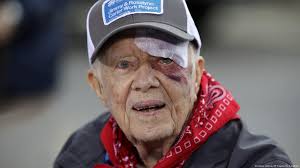

Jimmy Carter, a no-frills and steel-willed Southern governor who was elected president in 1976, was rejected by disillusioned voters after a single term and went on to an extraordinary postpresidential life that included winning the Nobel Peace Prize, died Sunday at his home in Plains, Georgia, according to his son James E. Carter III, known as Chip. He was 100 and the oldest living U.S. president of all time.
A cause of death was not immediately provided. In a statement in February 2023, the Carter Center said the former president, after several hospital stays, would stop further medical treatment and spend his remaining time at home under hospice care. He had been treated in recent years for an aggressive form of melanoma skin cancer, with tumors that spread to his liver and brain.
His wife, Rosalynn, died Nov. 19, 2023, at 96. The Carters, who were close partners in public life, had been married for more than 77 years, the longest presidential marriage in U.S. history. One of his final public appearances was at her funeral in Plains, where he sat in the front row in a wheelchair. Carter was last photographed outside his home with family and friends as he watched a flyover on Oct. 1 held to mark his 100th birthday.
Mr. Carter is survived by his children Jack, Chip, Jeff and Amy; 11 grandchildren; and 14 great-grandchildren, according to the Carter Center.
READ ALSO: 124 people killed as plane crashes at South Korea airport
“My father was a hero, not only to me but to everyone who believes in peace, human rights, and unselfish love,” Chip Carter said in a statement. “My brothers, sister, and I shared him with the rest of the world through these common beliefs. The world is our family because of the way he brought people together, and we thank you for honoring his memory by continuing to live these shared beliefs.”
The Carter Center said Sunday that public observances will be held in Atlanta and Washington, to be followed by a private interment in Plains. President Joe Biden said he ordered a national day of mourning on Jan. 9, but other details for the final arrangements, including all public events and motorcade routes, are still pending. Biden issued a proclamation ordering U.S. flags to be flown at half-staff for 30 days at federal buildings and military installations.
“Jimmy Carter stands up as a model of what it means to live a life of meaning and purpose, a life of principle, faith and humility,” Biden said in remarks earlier Sunday night. “What I find extraordinary about Jimmy Carter though is that millions of people all around the world, all over the world, feel they lost a friend as well, even though they never met him.”
Mr. Carter, a small-town peanut farmer, U.S. Navy veteran, and Georgia governor from 1971 to 1975, was the first president from the Deep South since 1837, and the only Democrat elected president between Lyndon B. Johnson’s and Bill Clinton’s terms in the White House.
As the nation’s 39th president, he governed with strong Democratic majorities in Congress but in a country that was growing more conservative. Four years after taking office, Mr. Carter lost his bid for reelection, in a landslide, to one of the most conservative political figures of the era, Ronald Reagan.
When Mr. Carter left Washington in January 1981, he was widely regarded as a mediocre president, if not an outright failure. The list of what had gone wrong during his presidency, not all of it his fault, was long. It was a time of economic distress, with a stagnant economy and stubbornly high unemployment and inflation.
“Stagflation,” connoting both low growth and high inflation, was a description that critics used to attack Mr. Carter’s economic policies. In the summer of 1979, Americans waited in long lines at service stations as gasoline supplies dwindled and prices soared after revolution in Iran disrupted the global oil supply.
Mr. Carter made energy his signature domestic policy initiative, and he had some success, but events outside his control intervened. In March 1979, a unit of the Three Mile Island nuclear power plant near Harrisburg, Pennsylvania, suffered a core meltdown. The accident was the worst ever for the U.S. nuclear-energy industry and a severe setback to hopes that nuclear power would provide a safe alternative to oil and other fossil fuels.
Mr. Carter’s fortunes were no better overseas. In November 1979, an Iranian mob seized control of the U.S. Embassy in Tehran, taking 52 Americans as hostages. It was the beginning of a 444-day ordeal that played out daily on television and did not end until Jan. 20, 1981, the day Mr. Carter left office, when the hostages were released.
In the midst of the crisis, in April 1980, Mr. Carter authorized a rescue attempt that ended disastrously in the Iranian desert when two U.S. aircraft collided on the ground, killing eight American servicemen. Secretary of State Cyrus R. Vance, who had opposed the mission, resigned.
“I may have overemphasized the plight of the hostages when I was in my final year,” Mr. Carter said in a 2018 interview with The Washington Post in Plains. “But I was so obsessed with them personally, and with their families, that I wanted to do anything to get them home safely, which I did.”
READ ALSO: Plane Crash: Putin apologises to Azerbaijan without claiming responsibility
A month after the Iranian hostage crisis erupted, an emboldened Soviet Union invaded Afghanistan. Mr. Carter ordered an embargo of grain sales to the Soviet Union, angering American farmers, and a U.S. boycott of the 1980 Summer Olympics in Moscow, a step that was unpopular with many Americans and was widely seen as weak and ineffectual.
As the years wore on, the judgment on Mr. Carter’s presidency gradually gave way to a more positive view. He lived long enough to see his record largely vindicated by history, with a widespread acknowledgment that his presidency had been far more than long lines at the gas station and U.S. hostages in Iran.
Near the end of Mr. Carter’s life, two biographies argued forcefully that he had been a more consequential president than most people realized — “perhaps the most misunderstood president in American history,” author Jonathan Alter wrote in his 2020 book, “His Very Best: Jimmy Carter, a Life.”
Both books — the other was Kai Bird’s 2021 volume, “The Outlier: The Unfinished Presidency of Jimmy Carter” — said Mr. Carter was often ahead of his time, especially with his early focus on reducing fossil fuel use and his efforts to mitigate the nation’s racial divide, including by expanding the number of people of color in federal judgeships.
The biographies concluded that Mr. Carter’s reputation as a poor president was unfair and came largely from his stubborn insistence on doing what he thought was correct even when it cost him politically.
“He insisted on telling us what was wrong and what it would take to make things better,” Bird wrote. “And for most Americans, it was easier to label the messenger a ‘failure’ than to grapple with the hard problems.”
Mr. Carter, noted for his mile-wide smile in public, was also tenacious and resolute, and those qualities were critical to achieving the Camp David Accords, a signature success of his presidency. He spent 13 days at the presidential retreat in Maryland’s Catoctin Mountains in September 1978, shuttling between cabins that housed Israeli Prime Minister Menachem Begin and Egyptian President Anwar Sadat. In a process that almost collapsed several times, Mr. Carter was instrumental in brokering a historic agreement between bitter rivals.
The Camp David Accords led to the first significant Israeli withdrawal from territory captured in the Six-Day War of 1967 and a peace treaty that has endured between Israel and its largest Arab neighbor. In 1978, Begin and Sadat were jointly awarded the Nobel Peace Prize, an honor conferred on Mr. Carter 24 years later for a lifetime of working for peace.